Specification
Specification 10 — Mode 1: Peer-to-peer threshold cryptography
N nodes on the internet do threshold cryptography directly with each
status: framework
Definition
N nodes on the internet do threshold cryptography directly with each other. No PKI required, no hierarchy, no certificates (beyond mutual TLS or Noise for transport auth).
When to use Mode 1
Use Mode 1 when:
- All participating nodes are known to each other (or discoverable via gossip)
- No hierarchical authority is needed
- Output is a single signature, decryption, or computation
- Latency matters more than institutional accountability
Architecture
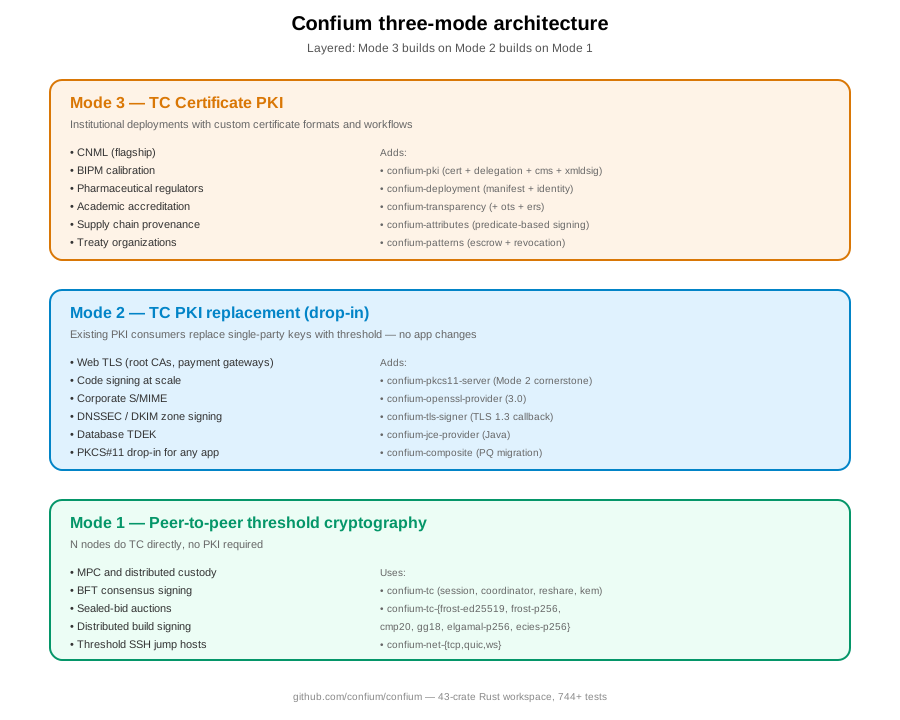
Mode 1 uses the foundational primitives only:
confium-tc(session, coordinator, reshare, kem)confium-tc-{frost-ed25519, frost-p256, cmp20, gg18, elgamal-p256, ecies-p256}confium-net-{tcp, quic, ws}transportconfium-storefor share persistence
Peer authentication
Each peer has an identity keypair (typically Ed25519 or ECDSA P-256). Peers authenticate each other via:
- Mutual TLS (recommended for TCP/QUIC)
- Noise Protocol (for ad-hoc connections)
- Pre-shared long-term public keys (most secure)
Session lifecycle
- Session create: any peer initiates with message + quorum ID
- Round 1: each participating peer broadcasts commitments
- Round 2 (or more): each peer sends shares
- Aggregation: any peer (or designated aggregator) combines outputs
- Output: final signature / decryption / computation result
Trust model
- Threshold property: T-1 peers cannot produce output
- Identifiable abort: misbehaving peers are detected via signed proofs
- No central coordinator required (any peer can aggregate)
Performance characteristics
- Round-trips: 2-3 for FROST, 3-4 for CMP20/GG18
- Per-round message size: ~100 bytes per peer
- Wall time on localhost: <50ms for 3-of-5 FROST-Ed25519
- Wall time over WAN: dominated by network latency (~100ms per round)
Implementation source
- Crate:
confium-tcand per-algorithm crates - Example:
confium-examples/src/bin/p256_threshold_signing.rs