Specification
Specification 01 — Three deployment modes
Confium supports three layered deployment modes.
status: framework
Overview
Confium supports three layered deployment modes. Each mode is a strict superset of the previous mode’s capabilities. Consumers use the appropriate mode for their use case.
Mode 1 — Peer-to-peer threshold cryptography
Definition
N nodes on the internet do threshold cryptography directly. No PKI, no hierarchy, no certificates (beyond mutual TLS or Noise for transport auth). They run a session, exchange messages, produce output.
Audience
Cryptography engineers, distributed systems engineers, blockchain developers, MPC application builders, applied researchers.
Examples
- Distributed key custody (cryptocurrency wallets, KMS clusters)
- BFT consensus signature production (validators, distributed ledgers)
- Multi-party computation with secret-output revelation
- Sealed-bid auctions (encrypted bids, threshold-open at close)
- Privacy-preserving analytics (threshold-decrypt aggregate results)
- Distributed build/signing pipelines (multiple build agents collaborate)
- Threshold SSH jump hosts (bastion cluster signs session certs)
- Distributed database encryption (TDEK held across regions)
Architecture used
confium-tc— session primitives + coordinator + reshare + kem (consolidated)confium-net-{tcp,quic,ws}— transport- One algorithm crate (
confium-tc-frost-ed25519,confium-tc-elgamal-p256, etc.) confium-storefor share persistence- Mutual TLS or Noise Protocol for transport auth
- Optional:
confium-tc-resharefor committee evolution
Time to value
Hours. Drop crate, write ~50 lines, run session.
Mode 2 — TC PKI replacement
Definition
Existing PKI consumers (web servers, code signers, email signers, VPN gateways, database encryption, PKCS#11 applications) replace single-party keys with threshold keys without changing their surrounding ecosystem.
Browsers still verify TLS normally; OpenSSH still works; OpenSSL still works. The PKCS#11 token they’re talking to is actually a Confium threshold coordinator dispatching to a quorum behind the scenes.
Audience
Corporate security teams, CA operators, DevSecOps architects, HSM-using enterprises, government PKI operators.
Examples
- Web TLS for high-value sites (root CAs, payment gateways)
- Code signing at scale (software vendors signing release artifacts)
- Corporate S/MIME email signing
- VPN gateway authentication
- Database TDEK
- DNSSEC zone signing
- DKIM email signing
- CA root key management
- PKCS#11 drop-in for any existing PKCS#11 app
Architecture used
Everything from Mode 1, plus:
confium-pki(cert submodule) — X.509 cert + CSR typesconfium-pkcs11-server— exposes PKCS#11 v3.0 API, dispatches internally to threshold protocol. The killer feature for Mode 2.confium-openssl-provider— OpenSSL 3.0 provider using Confiumconfium-tls-signer— TLS 1.3 signature callbackconfium-jce-provider— Java Cryptography Extension provider- HSM-backed share storage (PKCS#11, TPM)
- Optional:
confium-compositefor PQ hybrid signatures - Optional:
confium-transparencyfor high-value deployments
Time to value
Days to weeks. Deploy coordinator, configure HSM, integrate with existing PKI, test failover.
PQC migration
Mode 2 is the killer feature for PQ migration. Enterprises facing the 2024-2030 PQ transition can either:
- Replace all HSMs (years of vendor cooperation)
- Re-do threshold protocols per algorithm
- Re-issue all credentials
OR:
- Deploy Confium for PKCS#11 today
- Software upgrade to composite signatures tomorrow
- Software upgrade to PQ-only when ecosystem ready
- PKCS#11 interface unchanged throughout
Mode 3 — TC Certificate PKI
Definition
Organizations with their own certificate/document formats and workflow semantics. Custom delegation rules, custom verification pipelines, custom archival rules.
Audience
Institutional system architects — government tech leads, treaty org CIOs, regulator CTOs, accreditation body directors.
Examples
- CNML (flagship) — type approval certificates with model-bound delegation, 5-tier hierarchy
- BIPM calibration — SI-traceable calibration certificates
- Pharmaceutical regulator — drug applications, GMP certs
- Academic accreditation — diplomas with department/university/ accreditor tiers
- Financial audit firms — audit attestations with engagement/ partner/firm tiers
- Supply chain provenance — regulator/certifier/manufacturer/ shipper/customs
- Standards bodies — ISO/IEC standards with working group/ committee/body tiers
- Treaty organizations — international agreements with multi-national signatories
Architecture used
Everything from Mode 2, plus:
confium-pki(delegation submodule) — scoped delegation templatesconfium-pki(cms submodule) — CMS/PKCS#7 envelopeconfium-pki(xmldsig submodule) — XMLDSig + Exclusive C14Nconfium-deployment— deployment manifest with tier structure, quorum T/N, attribute predicates, delegation rules, async policies, transparency log policyconfium-transparency(transparency + ots + ers) — append-only Merkle tree with OTS anchoring and Evidence Record Syntax for long-term archivalconfium-attributes— attribute-based threshold party selectionconfium-patterns(escrow + revocation) — Thunderbird-inspired patterns
Time to value
Months. Design manifest, integrate, test, deploy, train.
How the modes relate
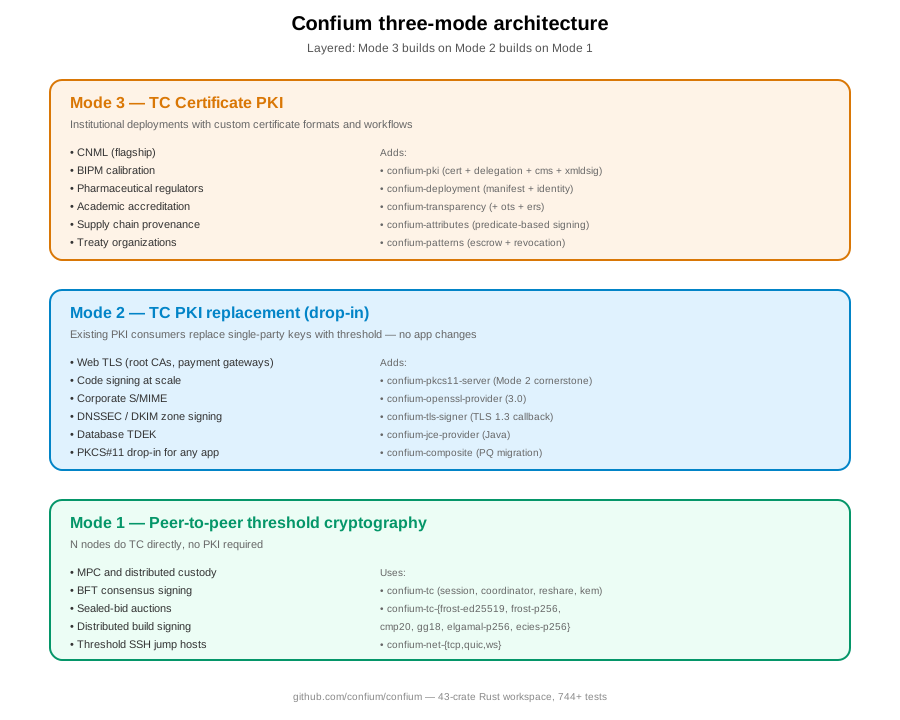
Layered. Mode 3 builds on Mode 2 builds on Mode 1. A deployment can use any mode or combination.