Specification
Specification 00 — Framework overview
Confium is an open-source framework for **multi-stakeholder threshold
status: framework
What Confium is
Confium is an open-source framework for multi-stakeholder threshold cryptography, providing the cryptographic, coordination, transparency, and PKI primitives required for deployments where no single party is trusted.
It is the reference implementation submitted to NIST MPTS (Multi-Party Threshold Cryptography) standardization, and anchors the CNML (Certificat Numérique de Métrologie Légale) flagship deployment under the SMART metrology program operated by Ribose.
Three deployment modes
Confium supports three layered deployment modes. Each mode is a strict superset of the previous mode’s capabilities.
Mode 1 — Peer-to-peer threshold cryptography
N nodes on the internet do threshold cryptography directly with each other. No PKI required, no hierarchy, no certificates (beyond mutual TLS for transport authentication).
Examples: MPC, distributed key custody, BFT consensus signing, sealed-bid auctions, threshold SSH jump hosts, distributed build signing.
Mode 2 — TC PKI replacement (drop-in)
Existing PKI consumers (web servers, code signers, email signers, VPN gateways, PKCS#11 applications) replace single-party keys with threshold keys without changing their surrounding ecosystem. Browsers still verify TLS normally; OpenSSH still works; OpenSSL still works. The PKCS#11 token they’re talking to is actually a Confium threshold coordinator dispatching to a quorum behind the scenes.
Includes the PQC migration path: composite signatures (classical + PQ) maintain verifier back-compat.
Examples: web TLS for high-value sites, code signing at scale, corporate S/MIME, DNSSEC, DKIM, CA root key management.
Mode 3 — TC Certificate PKI (special formats)
Organizations with their own certificate/document formats and workflow semantics. Custom delegation rules, custom verification pipelines, custom archival rules. CNML is the flagship.
Examples: CNML, calibration authorities, pharmaceutical regulator drug approvals, academic accreditation, supply chain provenance, treaty documents.
Architecture diagram
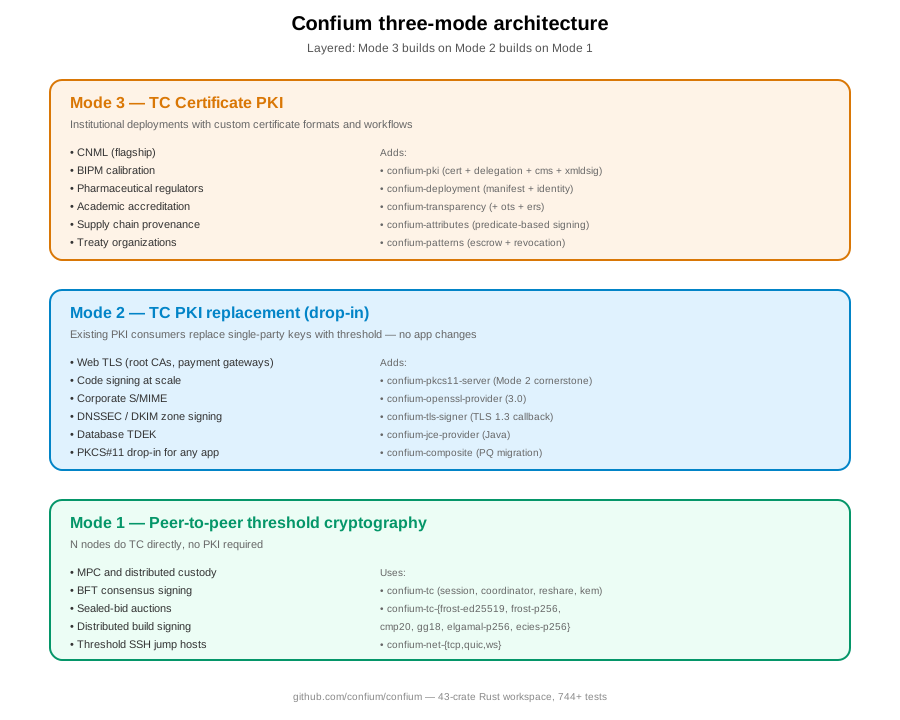
(See images/three-mode-architecture.svg for the high-level layout.
Mode 3 builds on Mode 2 builds on Mode 1.)
Layered architecture
Mode 3: TC Certificate PKI  (CNML, BIPM, pharma, accreditation)
   └─ adds: custom formats, scoped delegation, transparency, archival
        ↓ builds on
Mode 2: TC PKI replacement   (web TLS, code signing, PKCS#11, PQC migration)
   └─ adds: X.509 certs, CMS/TLS envelopes, PKCS#11 server, RFC compliance
        ↓ builds on
Mode 1: Peer-to-peer TC      (MPC, custody, BFT, wallets)
   └─ adds: nothing — pure protocol execution between authenticated peers
        ↓ builds on
Confium primitives           (sig + enc + reshare + coordinator + hardware)
Crate organization
The main confium/ Rust workspace contains 43 crates organized by
concern. See link:02-workspace-organization.adoc[02 — Workspace
organization] for the full layout.
Implementation source
- Source: https://github.com/confium/confium
- RustDoc: https://docs.rs/confium (and per-crate)
Status
Confium 0.3 is structurally complete with 744+ tests passing. The framework ships real cryptographic primitives (P-256 Shamir + ECDSA, threshold ElGamal, threshold ECIES with ECDH + AES-256-GCM, real CMS DER encoding, real Canonical XML, real RFC 6962 Merkle inclusion proofs) plus interfaces for all specified algorithms.
Pre-1.0 work continues toward stabilization.